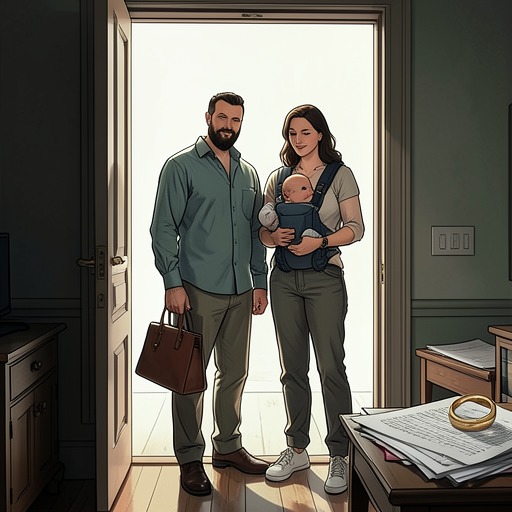
Rex and Nancy’s Reconciliation
Stolen WanderRex and Nancy’s Reconciliation turns a rescue into a test of whether love can be sustained by accountability rather than longing alone. Nancy’s intervention at the bar brings them face to face again, but their renewed relationship is not settled by the danger she interrupts. Rex has to acknowledge that he left when he learned she was pregnant, while Nancy weighs the risk of trusting him again. His departure from the club, a one-way plane ticket to Los Angeles, and an explicit commitment to stay give substance to his return; their later wedding shows that the reconciliation becomes a lasting family commitment.
Causes and Background
Before going to Nancy, Rex is prompted to examine what he means by love. After a slug of whisky, he privately asks Snake whether he has ever been with a woman he loved. Snake answers that he is still with the woman he loves, now his wife, and Rex is startled to learn that Snake is married. The exchange gives Rex a comparison with a relationship sustained beyond the casual encounters he knows, and it precedes his decision to seek Nancy out.
Rex rides toward her apartment in Salem, convinced that he needs to see her, but he does not treat the impulse as proof that he can be trusted. In the autumn drizzle, he stops several streets away and questions why he is going. He fears he might take what he wants from Nancy and leave again, repeating the very behavior that has already hurt her. Sitting on the curb as the rain grows heavier, he asks himself what he wants from her and what he could offer. His answer is not limited to sex: he wants to spend time with her as they did at The Mermaid, learn about each other, become closer, and see her smile. The pause makes the return a moral decision as well as an emotional one, though his doubts about his capacity to be dependable remain.
A second reckoning concerns Rex’s earlier fight with Bill O’Neill. Bill explains that Rex knocked him out with a single blow, humiliating him and making him feel that he was no longer the man he had once been. Bill also admits that he had allowed Ralf Michaels to pursue Rex and could no longer call him off. Rex recognizes that defeating Bill so decisively had helped provoke the vendetta. He apologizes for making the fight unfair and for humiliating him, and insists that he means it. This acknowledgment does not erase the conflict, but it marks a shift from defending his actions to taking responsibility for their consequences.
The Standoff and Reunion
At the bar, Rex and Nancy retreat to the booth where they once shared shots after the bikers search the area for police who might have stayed behind. The familiar seat recalls their earlier closeness, while their awkwardness makes clear that the relationship still needs repair. Nancy has just risked herself to stop the armed confrontation: she stood beside Rex and Ralf Michaels and appealed to the assembled officers and bikers to consider what their violence meant for Salem, their families, and their futures. Her words lead most of the men on both sides to lower their guns. Michaels keeps his weapon trained on Rex, and Snake keeps his on Michaels, leaving the danger concentrated around the pair even as the wider crowd begins to stand down.
In the booth, Rex tells Nancy that he had realized she was pregnant and that this was why he had run. The blunt admission makes the cause of his abandonment impossible to mistake. Nancy is angry that he left because of the baby, even while recognizing that fear of fatherhood may explain his reaction. She asks why he did not wake her so they could talk, and refuses to accept sarcasm in place of an explanation. Her return to him does not automatically restore his place in her life: she says she must decide whether to take him back.
Rex offers a future in concrete terms. He says he will look at the ultrasound, be there when the child is born, and take the child to school and soccer. Nancy answers with the central objection: he already walked out and failed to return, so she cannot know he will not disappear again. His promises are therefore tested against the history of his actions, not received as reassurance by themselves.
The Choice to Return
Rex answers that he has left the Sons of Wolves Motorcycle Club and explains that he has been banished from Salem. He presents that separation as a choice made for Nancy and their future, not as proof that she owes him another chance. Then he slides an envelope across the table. Inside is a one-way plane ticket to Los Angeles, with departure in four hours. Nancy realizes that he had intended to fly out to find her and had given up his club to do so. The ticket changes the meaning of his return: he had not simply come back to the familiar place where she was waiting, but had prepared to cross the distance between them.
That gesture does not silence Nancy’s need for assurance. When they go to her car, Rex asks to drive, explaining that he would not let his pregnant fiancée drive. Nancy catches on the word fiancée and asks whether he is serious. He confirms that he loves her and says he will no longer let his personal problems obstruct their relationship, while admitting that he may not manage perfectly. Nancy asks him to promise he will stay until the baby is born. Rex says he is staying, although he warns that he may sometimes be difficult. The exchange joins a declaration of commitment to a less polished admission: staying is the promise; effortless change is not.
Family, Change, and Ending
The reconciliation also opens onto Bill’s effort to change. Later, Bill comes to Nancy’s apartment with bloodshot eyes that reflect sadness rather than his usual anger when drinking. He tells her he has arranged to enter a rehabilitation program lasting one year, including three months without contact with the outside world. Weeping, he apologizes for the childhood she endured and for the suffering he caused her mother. Nancy comforts him but does not claim that forgiveness is complete; she wants him to get better. When Bill asks for a hug, she embraces him for the first time since she was a little girl, as far as she can remember. The gesture is awkward and imperfect, but she recognizes it as a beginning.
Rex connects Bill’s decision with his own departure from the club. He reflects that people can remain trapped for years in lives they entered for money, anger, or a sense of importance, and that choosing not to fight can itself be an act of bravery. He describes his struggle as an inner war in place of a real one. The parallel does not make their situations identical: Bill must pursue rehabilitation, while Rex has left the club and must prove he can remain present. Together, these choices frame reconciliation as an ongoing effort to interrupt established patterns, not as an instant cure for addiction, violence, or fear.
The later wedding gives that effort a public measure. Rex still has thoughts of running the night before, not because he does not want to marry Nancy, but because he doubts that he deserves her. He cannot resolve that doubt in advance; instead, he imagines spending the rest of his life trying to become worthy of the answer. At the ceremony, Nancy’s mother walks her down the aisle, while her family and Sal and his wife are present. Rex sees their son, Sebastian, smiling and reaching toward Cheryl, and feels a protective warmth toward Nancy and the child. He says he does, repeating the answer, and promises Nancy that he will always have her. The wedding does not erase the earlier abandonment or guarantee that the work of change is finished. It makes the reconciliation’s decisive development visible: Rex’s return becomes a chosen, witnessed commitment to Nancy and their family.